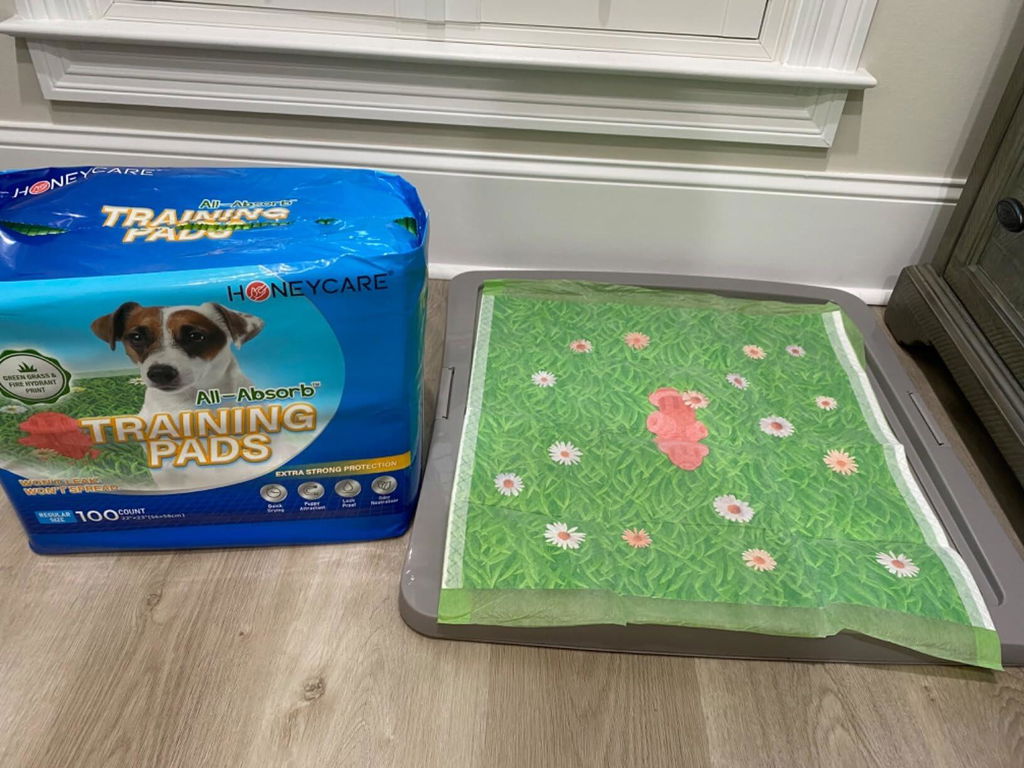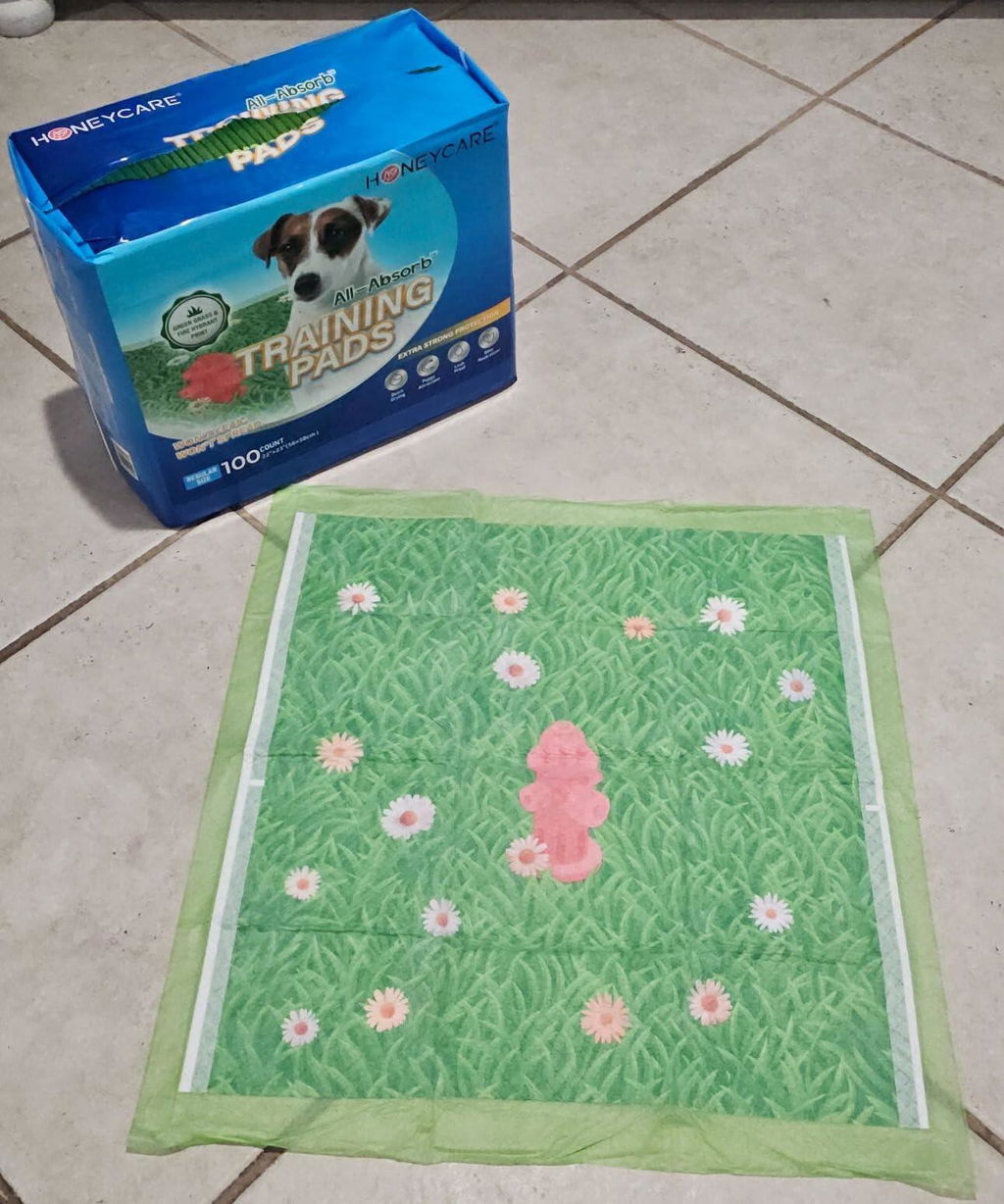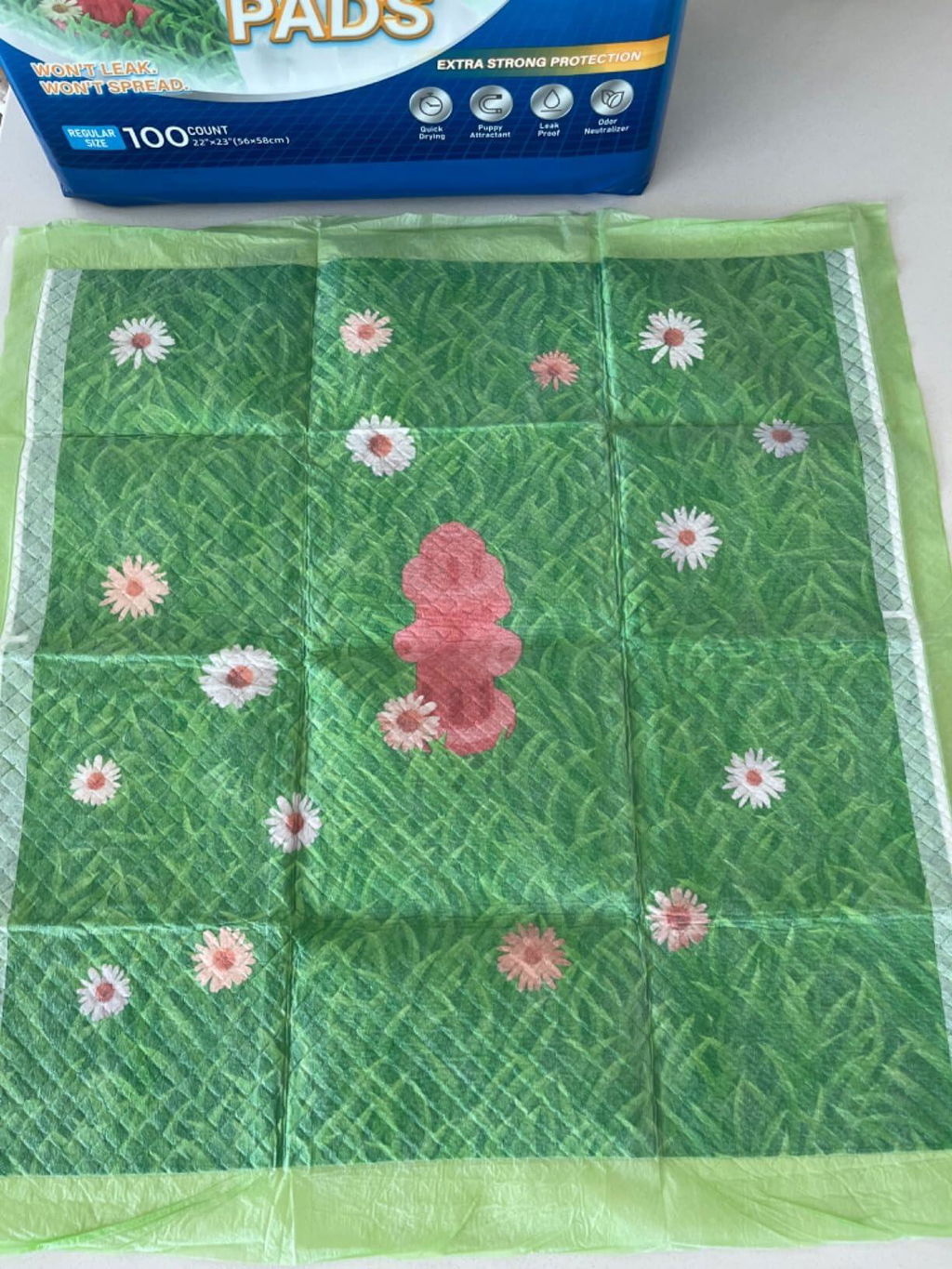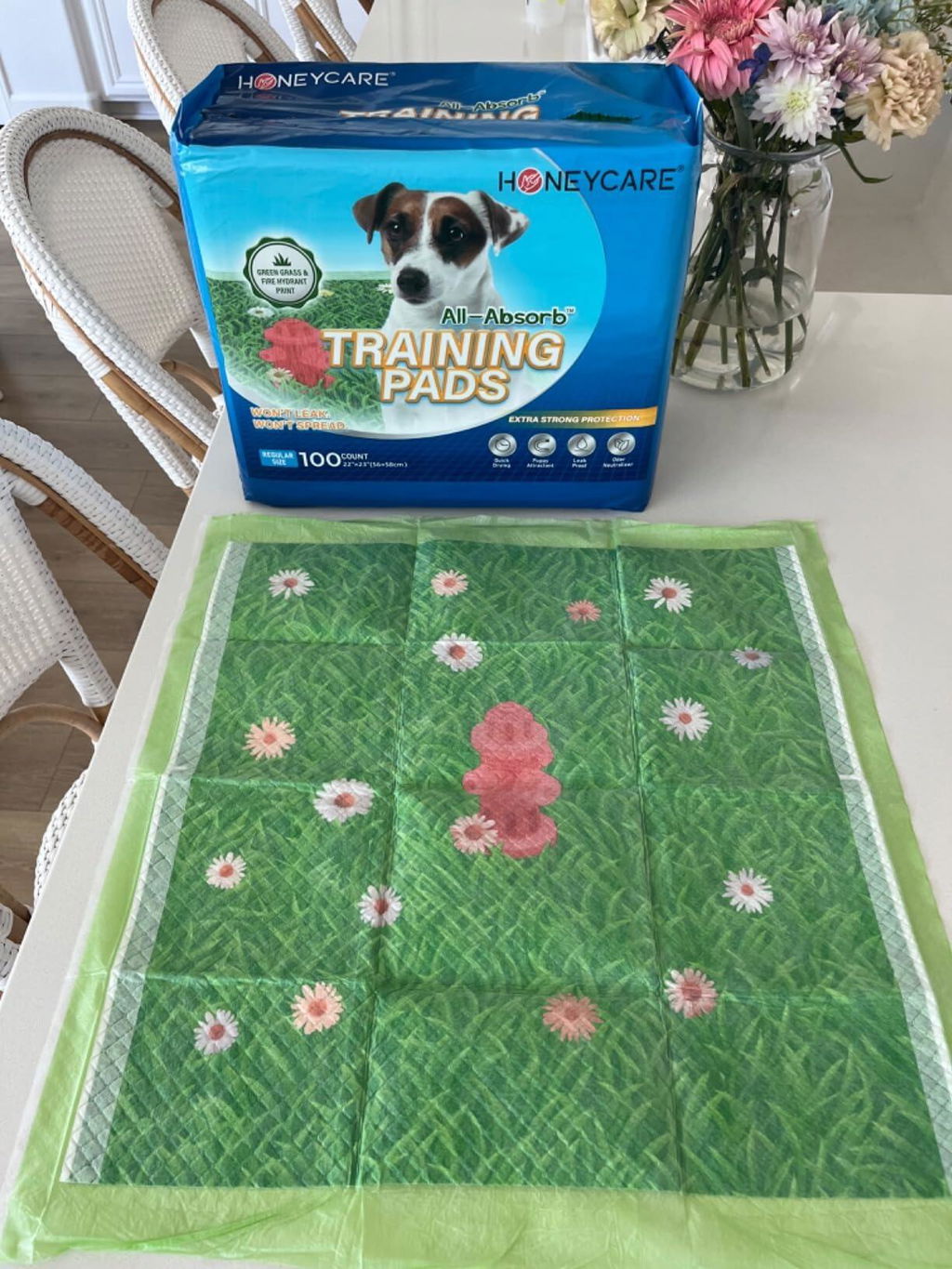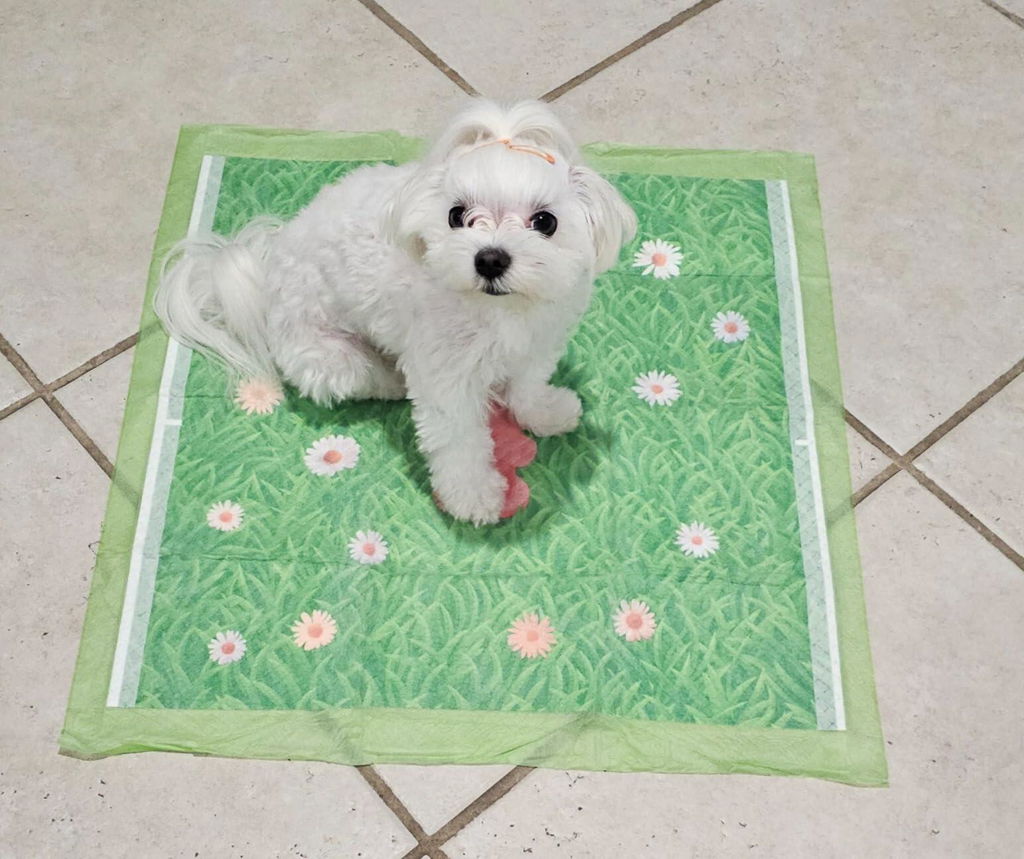



HoneyCare® Dog and Puppy Training Pads with Printed Grass
Spend $80, Get $5 Off! code:HC5
- Description
- Return & Exchange
Super Absorbency/All-Absorb™ Technology
Absorbent tissue instantly absorbs liquids and super absorbent polymer locks liquids in the absorbent core.
Odor Neutralizer
Super absorbent polymer locks liquids in the absorbent core, turning liquids into gel and minimizing odors.
6-Layer Technology for No Odors and No Leaks
Multi-layered design, including super absorbent polymer, a wood pulp layer and leak-resistant edge, ensures 360° leak-proof protection.
Built-in Attractant
Featuring a built-in attractant, the pad is specifically designed to make training easier and more effective by drawinig your dog to the correct spot.
Adhesive Tape
Adhesive tape keeps the pad securely in place, preventing slipping and shifting and avoiding messes on floors.
You may request a return or exchange of unused, unopened HoneyCare pet diapers within 14 days of receipt by contactingservice@honeycarepet.com. Customers cover return shipping costs, and refunds are processed within 5-7 business days after inspection, Damaged or defective items reported within 7 days will be replaced or refunded at no extra cost.
HoneyCare® Training Pads with Printed Grass are disposable indoor potty pads with a green grass print and a built-in attractant, so a puppy who has never been outside still has something that looks and smells like the right place to go. Use them for puppy potty training, apartments with no fast route to a yard, senior dogs who cannot hold it overnight, crate rest after surgery, and travel.
Each pad has a 5-layer core: a quick-dry non-woven top sheet, two absorbent layers, a poly core that turns urine into gel so it cannot be squeezed back out, and a waterproof plastic backing. Adhesive tape on the corners holds the pad to the floor, which is what stops the 3am discovery of a pad kicked into the corner and a puddle where it used to be.
Who this is for
| Your situation | Is this pad right? |
|---|---|
| New puppy who keeps going on the rug instead of the pad | YesThe grass print and attractant give him something to aim at. Rugs lose their appeal once the pad smells more like the right spot than the carpet does. |
| Apartment or high-rise — the elevator is too slow for a puppy bladder | YesOne fixed indoor spot he can reach in five seconds, so accidents stop being about timing. |
| Senior dog leaking overnight, or too stiff to make it to the door | YesPut it right beside his bed. Arthritic dogs will not cross a room at 4am — they will just go where they are. |
| You work long shifts and come home to a mess | YesSize up rather than laying two pads side by side. Dogs aim for the middle of one target, not the seam between two. |
| Post-surgery crate rest, or a dog on medication that makes him pee more | YesDry bedding matters around a healing incision. Change more often than usual during recovery. |
| Hotel rooms, car trips, RVs, a relative's spare room | YesThe tape grips hard floors, so it will not slide when he circles before going. |
| Whelping box, grooming cage, or a litter of puppies | YesRegular size at 400 pads per box is the cost-effective option when you are changing pads many times a day. |
| Cats, rabbits, ferrets and other small pets | YesWorks as a litter-box liner or an under-cage layer. |
| You eventually want him going outside, not on a pad | Check firstPads make the transition slower the longer you wait. Start moving the pad toward the door early — how to switch to outdoors. |
| He shreds pads, or you have caught him chewing one | Check firstSwallowed gel beads mean a vet visit. Fix the chewing first — how to stop pad shredding. |
| He leaks while walking around, or marks vertical surfaces | NoA pad only protects the floor it covers. Urine that travels needs a diaper or belly band instead. |
| Outdoors — on grass, gravel, or a balcony with a drain | NoThe waterproof backing needs a flat dry floor to seal against. On soil or through a drain grate it has nothing to hold the liquid over. |
Size chart — match the pad to your dog, not to the price
Dogs aim for the centre and drift toward the edge as they turn, so a pad that only just fits is the single most common reason people say a pad "leaked". Measure your dog nose-to-tail-base, then pick a pad roughly that long — or go bigger if he circles a lot before going.
All three sizes cost the same, so the pad count changes instead. Regular ships 400 pads (100 per pack × 4). XL and XXL ship 120 pads (30 per pack × 4). If a small pad covers your dog, Regular is roughly a third of the cost per pad. Choose XL or XXL when coverage is the thing that is failing you.
| Size | Pad size | Pads per box | Which dogs this fits |
|---|---|---|---|
| Regular | 22 × 23 in56 × 58 cm | 400 pads100 per pack × 4 | Puppies up to about 20 lb, toy and small breeds — Chihuahua, Yorkie, Maltese, Pomeranian, Dachshund, Shih Tzu, Pug, small terriers. Also the right choice for litters and any high-volume daily use. |
| XL | 28 × 34 in71 × 86 cm | 120 pads30 per pack × 4 | Medium and larger dogs roughly 20–60 lb — Beagle, Cocker Spaniel, French Bulldog, Border Collie, Australian Shepherd, Corgi, Bulldog. Also the right size for a growing large-breed puppy who has outgrown Regular. |
| XXL | 30 × 36 in76 × 91 cm | 120 pads30 per pack × 4 | Large and giant breeds over about 60 lb — Labrador, Golden Retriever, German Shepherd, Husky, Boxer, Rottweiler, Great Dane, Mastiff. Also best for overnight coverage, a shared station for two dogs, or any dog who reaches the edge of an XL. |
Weight ranges are a starting point, not a rule — a long-bodied 25 lb Dachshund often needs more length than a compact 35 lb Frenchie. If your dog spins two or three circles before going, size up. Detailed guides: pee pad size chart · when you need XXL · best pads for small dogs · pads for large dogs
Frequently asked questions
My dog pees right next to the pad instead of on it. Why?
Nine times out of ten the pad is too small for him. Dogs step forward as they go, so a dog whose body is longer than the pad will start on it and finish on your floor. Move up one size before you change anything else about your routine.
The other common cause is placement. If the pad is in a corridor, near his food, or somewhere he gets stepped over, he will pick a quieter spot instead. More fixes: peeing around the pad · best placement
What size pad does my dog need?
Match the pad length to your dog's body length, nose to base of tail, and go one size up if he circles before going. Regular 22 × 23 in covers toy and small breeds and puppies up to about 20 lb; XL 28 × 34 in covers medium dogs and large-breed puppies; XXL 30 × 36 in covers large and giant breeds, overnight use, and two dogs sharing one station.
Do not go by weight alone. A Dachshund and a French Bulldog can weigh the same and need different pads, because one is long and one is compact. Full walkthrough: pee pad size chart
Why are all three sizes the same price?
Because you are buying a box, not a pad — and the boxes hold different quantities. Regular ships 400 pads, XL and XXL ship 120. That works out to roughly 26¢ per pad for Regular and 88¢ for XL or XXL.
So if a Regular pad genuinely covers your dog, it is the cheaper way to buy. Size up only when coverage is the problem, not to get more pads.
How many pads will my puppy go through in a day?
Expect 4 to 6 pads a day for a young puppy in the first weeks, dropping to 1 or 2 as bladder control develops around 4–6 months. A rough guide is one pee per month of age per day, plus accidents — an 8-week-old puppy needs a pad change every couple of hours while awake.
This is why Regular at 400 pads works out so much better for puppy training specifically. More detail: how many pads per day
How often should I change the pad?
Change it after one or two uses, or once a day at minimum even if it looks dry. The gel core locks liquid away so the surface still feels dry when the pad is half used, which is exactly why people leave them down too long — and then the dog refuses to use a pad that smells stale.
Overnight and hot weather both shorten that window. In summer, odour builds faster than absorbency runs out.
Does the grass print and attractant actually work?
The attractant helps most with puppies and with dogs who have never used a pad before, because it gives them a scent cue that says "here". It is a nudge, not a switch — it will not override a dog who already has a favourite spot on your rug.
The grass print works on you as much as on the dog: it makes the pad read as a designated potty area rather than a stray sheet of paper, which means people tend to place it more consistently. If your dog is already pad-trained, the print is cosmetic. More: does attractant really work
The pad slides around or my dog kicks it up. What do I do?
Use the adhesive tape on all four corners and press them down onto a clean, dry floor — tape will not stick to dust or a slightly damp tile, which is why it sometimes seems not to work. On carpet, tape has nothing to grip, so use a pad holder or tray instead.
If he is deliberately dragging it, that is usually play or boredom rather than a problem with the pad. More: keeping pads from sliding · pad holders reviewed
Will urine soak through to my hardwood floor?
No — the bottom layer is waterproof plastic, so liquid cannot pass through the pad itself. What does damage floors is urine running off the edge when a pad is undersized or overloaded, then sitting under the pad where you cannot see it.
On hardwood, that is the case for sizing up and changing more often rather than buying a thicker pad. More: pads on hardwood · protecting the floor underneath
How do I stop the pad smelling up my apartment?
Bag each used pad before it goes in the bin — the smell in a small apartment usually comes from the bin, not the pad on the floor. A lidded bin near the pad station, emptied daily, fixes most of it.
Also clean the floor under the pad weekly with an enzymatic cleaner. Ordinary cleaners leave scent markers your dog can still smell, so the area keeps smelling faintly of urine to both of you. More: stopping pad smell in an apartment · odour control guide
My dog used the pad fine for months and suddenly stopped. What changed?
Check for a urinary tract infection first — a sudden change in a previously reliable dog is a medical symptom often enough that it is worth ruling out before you retrain anything. Straining, going more often, or small frequent puddles all point that way.
If he is healthy, look at what moved: a new pad brand, a relocated station, new furniture, a house guest, or a pad left down too long. Dogs are specific about the spot, and they will quietly pick a new one rather than tell you. More: why dogs suddenly stop · fixes
Can I put a pad in his crate?
Usually not while you are crate training, because it teaches him it is acceptable to go where he sleeps — and that undoes the main advantage of a crate. Take him out instead, even overnight, while he is learning.
There are exceptions: a puppy left longer than he can physically hold it, a senior dog, or a dog on crate rest after surgery. In those cases a pad is the kinder option. More: pads in a crate · crate training with pads
Will using pads make it harder to train him to go outside later?
It can, and the longer you wait the harder it gets — so if outdoors is the goal, start moving the pad toward the door within the first few weeks rather than after a year. A dog who has used a pad in the same spot for two years has a firmly established habit.
Pads are not a dead end though. They are the right call for apartments, winter, long work shifts, and puppies who are not fully vaccinated yet. Plan the transition rather than avoiding pads. More: transitioning outdoors · do pads confuse dogs
Are the gel beads safe if he chews the pad?
The polymer is non-toxic, but a chewed pad is still a real risk — swallowed gel absorbs liquid and swells, and plastic backing can cause a blockage. Call your vet if he has eaten part of a pad, especially a small dog.
If he is a chewer, deal with that before relying on pads: supervise, use a covered holder, and give him something better to chew. More: risks of eating pads · stopping shredding
Can two dogs share one pad station?
Yes, and XXL is the size that makes it workable — but expect to change it more often, because the second dog is far more reluctant to step onto a pad the first one has already used. One shared station that is always fresh beats two stations they both ignore.
If one dog starts avoiding it entirely, give them separate spots out of sight of each other. More: managing multiple dogs · two dogs, one spot
Can my cat use these?
Yes — as a litter-box liner, under the box to catch overshoot, or as the surface itself for a cat who has stopped using litter. They are also useful for cats recovering from surgery who cannot manage a high-sided box.
Cats do not respond to the dog attractant, so for a cat you are buying the absorbency and the waterproof backing, not the training cue.
Do I need a diaper as well as pads?
They solve different problems. A pad protects one patch of floor and the dog has to choose to use it. A diaper or belly band travels with the dog, which is what you need for a senior who leaks while walking, a dog who marks furniture, or a female in heat.
Plenty of people use both: a diaper during the day while you are out, pads as the overnight station. More: using both together · HoneyCare diapers and wraps